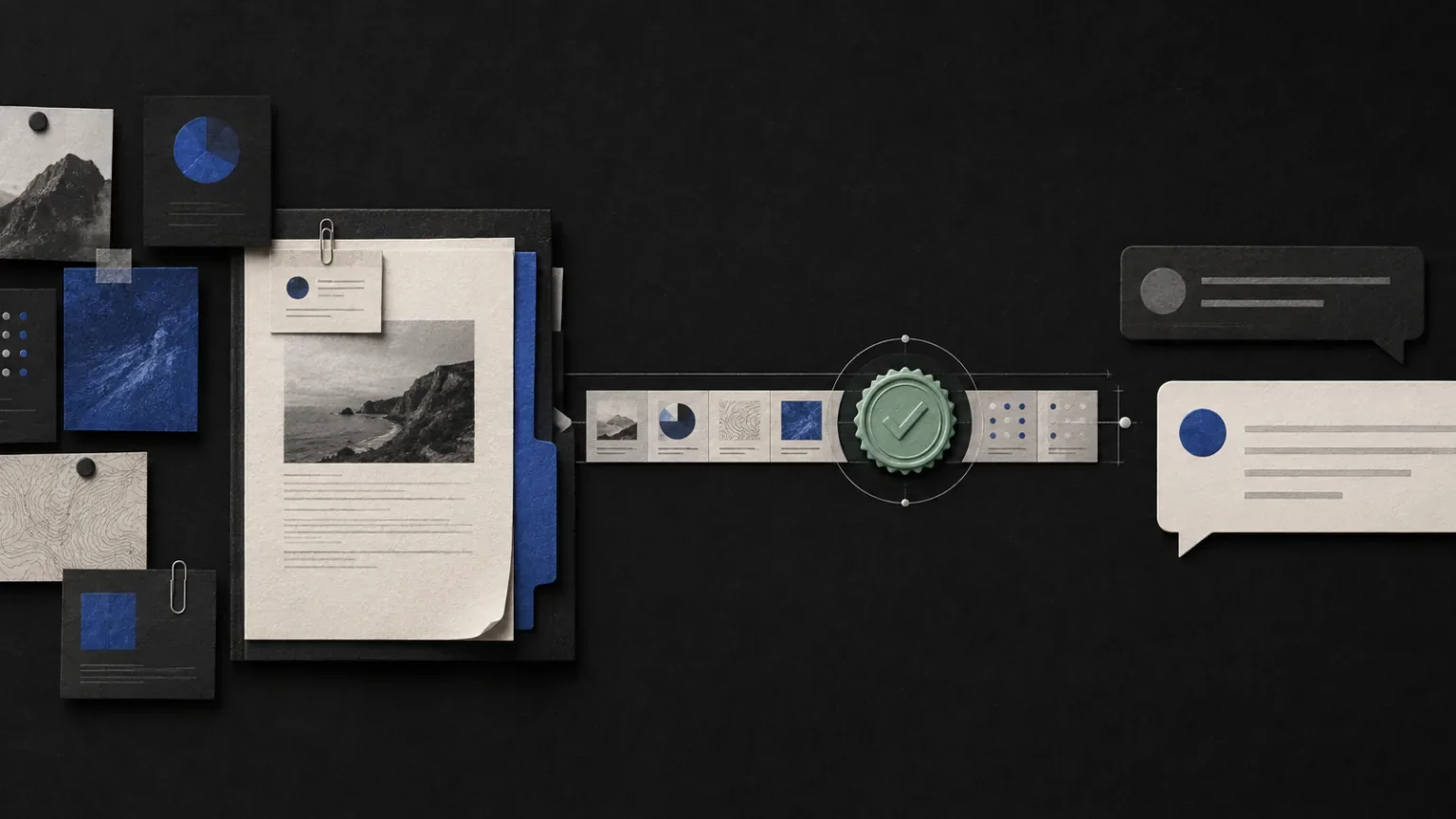
The difficult part of answering a live-chat question is rarely producing a sentence. It is knowing whether that sentence represents the creator accurately.
A general AI model can produce a confident answer about almost anything. A useful live assistant has a narrower job: answer from material the creator controls, keep the response short enough for chat and avoid guessing when the available context is weak.
That difference is what “grounded” means in practice.
Begin with questions viewers actually ask
A creator knowledge base should not start as a giant encyclopedia. Begin with the recurring questions that interrupt the flow of a stream:
- What gear are you using?
- Where can I find the full course?
- What are the community rules?
- Which settings are active today?
- How can I support or join the project?
Each answer should be useful on its own because live chat rarely provides space for a long introduction. Write the direct answer first, then include the most important qualifier or link.
Channel scanning can help surface likely questions from published material, but discovery and approval are separate jobs. A proposed answer should become live knowledge only after the creator has reviewed it.
Use short answers and documents together
Looomy treats creator knowledge as two complementary sources.
The first is a collection of approved question-and-answer entries. These are concise, predictable and available as direct context. They are well suited to stable facts such as links, recurring explanations and community policies.
The second is a collection of documents that can be searched for relevant passages. Documents are useful when the source material is too detailed to compress into a collection of hand-written answers: course notes, setup guides, product documentation or event information.
One source does not have to run before the other. A live answer can draw on the relevant material available across both, while still respecting the creator's approved boundaries.
Approval is a product feature
Human review is sometimes treated as temporary friction that better automation should remove. For a creator-facing assistant, review is part of the trust model.
Approval lets the creator decide:
- which claims are current;
- which links should be shared publicly;
- how much detail belongs in chat;
- whether a topic should be answered at all;
- when an old answer needs to be retired.
It also makes correction straightforward. If an answer shown during a stream is incomplete, the creator should be able to revise the durable knowledge instead of hoping a prompt behaves differently next time.
Silence is better than invention
Live chat rewards speed, but an immediate wrong answer creates more work than a delayed correct one. When context is weak, the responsible behavior is to preserve the question for review or leave it unanswered.
That restraint matters for recommendations, schedules, prices and personal details—areas where an outdated answer can sound plausible long after it stops being true.
A useful confidence policy should therefore distinguish between:
- a direct answer supported by approved knowledge;
- an answer supported by a relevant document passage;
- a question with insufficient context.
The third state is not a system failure. It is an opportunity to improve the knowledge base deliberately.
Write for the live moment
An answer that works in a help center may still fail in a fast-moving chat. Keep the first message compact and lead with the action or fact the viewer needs.
Instead of explaining the entire history of a setup, answer the exact question and point to the full guide. Avoid unnecessary greetings, repeated disclaimers and generic enthusiasm. The creator's personality should shape the voice, but the answer still needs to survive platform message limits and a crowded room.
Review answers on a phone-sized chat panel. If the useful sentence disappears below a wall of setup, rewrite it.
Improve the knowledge after every stream
The best knowledge base grows from observed gaps rather than imagined completeness. After a stream, review:
- questions that received no answer;
- answers moderators corrected manually;
- topics viewers asked repeatedly;
- links that received follow-up confusion;
- answers that were technically correct but too long.
Turn the strongest recurring question into a concise approved entry. Move detailed supporting material into a document. Remove knowledge that is no longer true.
This creates a useful loop: published material teaches the assistant, live questions reveal what is missing and creator review improves the next stream.
Trust comes from visible boundaries
Creators do not need an assistant that speaks about everything. They need one that represents what they know, in the moments where repetition pulls attention away from the audience.
Grounded answers work because their boundaries are understandable: creator-controlled sources, explicit approval, chat-length delivery and silence when evidence is weak. See how that fits into the complete Looomy workflow, from connecting a channel to running the live layer.